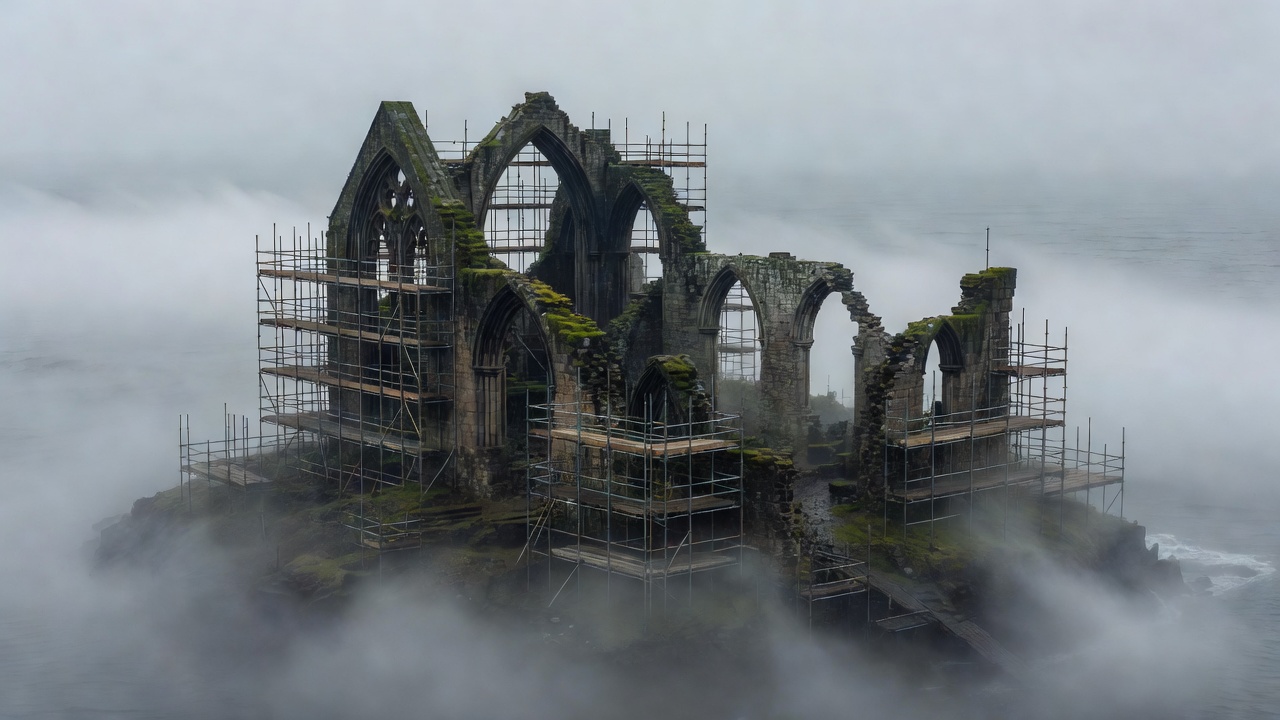
New York City is defined by relentless progress. Buildings are demolished, rebuilt, and repurposed in a continuous cycle of urban renewal. It is a city that rarely tolerates dead space. Yet, floating in the East River between the dense grids of Manhattan and Queens, there lies an unexpected pocket of decay: the Renwick Ruin on Roosevelt Island.
Taking the aerial tramway over the river to Roosevelt Island feels like crossing a threshold into a slower, quieter New York. Heading to the southern tip of the island, past modern residential blocks and manicured parks, you are suddenly confronted with an arresting sight: the ivy-draped, crumbling gothic facade of a 19th-century hospital.
Architecture of Quarantine
Designed by James Renwick Jr., the same architect responsible for the magnificent St. Patrick’s Cathedral on Fifth Avenue, the Smallpox Hospital opened in 1856. At the time, Roosevelt Island (then known as Blackwell’s Island) was effectively the city's dumping ground for its most undesirable elements. The island housed a penitentiary, a lunatic asylum, and hospitals for the critically infectious.
"Standing before the ruins, with the gleaming glass towers of Midtown Manhattan directly across the water, the contrast is jarring. It is a visual clash of New York's past and present."
Smallpox was ravaging the dense, unsanitary tenements of lower Manhattan. The solution was quarantine by water. Patients were ferried across the East River to the imposing Gothic Revival structure. Many never returned. The architecture, with its pointed arches and heavy stone masonry, was designed to look institutional and formidable—a clear boundary between the healthy city and the infected island.
The Descent into Ruin
As medical science advanced and smallpox vaccines became widespread, the hospital's original purpose became obsolete. It was repurposed as a nursing school and maternity ward before finally being abandoned in the 1950s. While the rest of New York City surged upward in steel and glass, the Renwick hospital was left to the elements.
Roofs caved in, stone walls fractured, and nature reclaimed the footprint. It became a genuine gothic ruin in the middle of a modern metropolis.
Preservation by Neglect
What makes the Renwick Ruin truly unexpected is that it survived the city's ruthless real estate market long enough to become a landmark. In 1975, the Landmarks Preservation Commission designated the ruin as a city landmark—the only ruin in New York City to hold that status.
Today, the structure is stabilized by steel bracing to prevent total collapse, and illuminated at night, casting eerie shadows across the river. You cannot walk inside the building, but you can approach the perimeter fencing and look through the empty, pointed windows into a time when the river was a moat, and the island was a place of last resort.